
Tuesday, 15 November 2016

Tuesday, 8 November 2016
Leadership Magazine: Fixing a reputation is simple, not easy November 2016

Here's the link to the article, it's on page 142.
Everyone has a reputation, albeit a good or bad one. The question in business is, what percentage of your own leadership style is contributing to the overall reputation of your organisation?
Before we answer that, let’s take a step back and look at the ‘so what?’ of reputation management. Why is reputation important? A research study conducted by the World Economic Forum found that 25% of an organisation’s bottom line is linked to its reputation. A quarter of the value of your organisation boils down to how you are perceived. With this in mind it’s worth getting a thorough understanding of what is building or breaking down your reputation.
People want to be associated with companies with a positive reputation, because by association they also look good. Companies with a good reputation are incredibly focussed on what it is they want to do, and how they are going to get there. They are clear on the values that drive their decision making. This central message is echoed through all the different channels of communication to their various stakeholder groups. When everyone has a very clear understanding of where they are going, it is a lot easier to be innovative and look for ways to achieve the desired end point, without being distracted by the unimportant.
Organisations perceived to have strong, stable brands, attract top employees; they can pick and choose from the talent pool and decide who they want on their team. They will opt for strong candidates that resonate with the company’s values, people who can perform at a certain level to ensure expected outcomes. Having the top recruits on board and giving them the freedom to be innovative, encourages growth within the organisation. Customers can then invest their hard earned cash into a particular product or service that they really want. Profits earned by the company can be used to re-invest into the teams and technology as well as making socially responsible commitments to uplift the communities within which they operate. All of this contributes to the overall reputation of the organisation.
The same goes for an organisation that does not have a positive reputation; it will be difficult to recruit a team as low morale impacts productivity. Service delivery will be affected and ultimately the investments that customers are willing to make will be compromised; leaving the crux of what keeps the business afloat in serious doubt.
Returning to the question posed earlier, what impact does your personal reputation have on the business? In my opinion, most people in senior positions think that they can separate their personal life from business. As much as you may want to keep your personal life just that, personal; your work and personal life will embody the same values. You can’t have a different set of values when you are at work and then chop and change it around when you head back home. When it comes to reputation management, three key words pertinent for any leader, are authenticity, integrity and consistency.
Your core values and the way that you conduct yourself on a daily basis filter down through the organisation. You are steering the ship and leading by example. I do sometimes wonder what example the leaders of our country are setting for our nation. With that said it’s not only a question for South Africa, take a look at the current USA election race. What example is this ‘first world’ country setting for the rest of the world? People in high places seem to get away with making ridiculous statements to get attention; they rant and rave on public forums, but at what cost to their reputation?
On a recent flight to Johannesburg I had a conversation about this specific topic with a gentleman who hit the nail on the head when he said, “It is the arrogance of power that lets people think that they can get away with the things that they say and do in the public domain.”
Is that perhaps why we have so many young people making ludicrous statements where, to the rest of us, they are clearly losing sight of reality by thinking that rules are no longer applicable to them? The recent #sciencemustfall farce is one example. In times like this I return to the wisdom of Abraham Lincoln who said,
“Better to remain silent and be thought a fool than to speak and to remove all doubt.”
With that said, it is about knowing what to say and when. Once you’ve uttered a word, it cannot be unsaid. When we present media training workshops, we always warn participants against “going off record,” if you don’t want it in the public space, don’t mention it. I think people often say and do things without thinking about the consequences; the thrill of the attention is blinding and leads to over inflated egos that need continuous feeding. When the attention dwindles, they think of more absurd ways to feed the ego monster.
Can a reputation be rectified if you’ve done something dodgy or said something incredibly stupid? Fixing a reputation is simple, but not easy, and some situations can’t just be “PR’d” away. If you’ve messed up, take responsibility, own up to it, be empathetic to those that are affected and indicate what you plan on doing to prevent this from happening again. It boils down to the three pillars of reputation that I mentioned earlier; being authentic, having integrity and showing consistency. The key is to apply these words to every aspect of your personal and business life.
Keen to continue the reputation conversation? Join Regine on Twitter @ReputationIsKey or Facebook www.facebook.com/yourreputationmatters.
Thursday, 3 November 2016
Beeld: Belê in die beste mense vir jou maatskappy, en bou 'n goeie reputasie, 26 Oktober 2016

Here's the English version:
Selecting the cream of the crop for your organisation
“If you think it's expensive to hire a professional to do the job, wait until you hire an amateur”, wise words from Red Adair, an American oil well fire fighter.
When managing the reputation of any organisation, investing in the right people to do the job means that you are investing in the quality of your output.
Regine le Roux, Managing Director at Reputation Matters, mentions that human capital is a vital element when establishing and building on a positive reputation for your organisation: “Identifying the right calibre of people during the recruitment phase is directly aligned to the strategic intent of the organisation; knowing exactly where you are going with your business and who you need on your team to get you there. Getting this right at the onset will save you a lot of time, frustration and money in the future.”
How do you select the cream of the crop for different positions? Here are some tips:
1. Set up strategic alliances: In order for you to build your reputation, you would need to employ individuals who can do the job and be an ambassador for your organisation. “At Reputation Matters we have really good strategic alliances that helps feed the recruitment funnel. We have a great relationship with the University of Pretoria’s Communication Management Department and offer their top BCom Communication Management honours students internship opportunities with us,” mentions le Roux.
2. Implement a rigorous recruitment programme: Having a set recruitment programme for all applicants, in both small and larger organisations, is essential. “By having an in-depth online application form or process, you will be able to determine whether the person is serious about wanting the position; if they are, they will complete the form in full. It also demonstrates their basic use of spelling, grammar and industry knowledge,” says le Roux.
3. Test their communication skills and contact references: The next round should always involve a phone call to determine how the candidates handle themselves telephonically. If they pass with flying colours, the first face-to-face interview is set up. “Should the interview go well, check references and then do personality profiling to get an idea of how they will fit in with the rest of the team. Culture fit is extremely important in any organisation and this needs to be determined from the get go,” adds le Roux.
4. Presentation of a case study: “As the final step of our recruitment process, the candidate is given a case study to prepare and present to our team. By implementing this, we are able to pick the best candidates for different positions as it often highlights their strengths and shows their way of thinking,” mentions le Roux.
Le Roux explains that once you have selected the ideal candidate, a thorough induction is necessary to help them get to grips with ‘how things are done around here’. “During this session the vision, core values and culture are discussed. This instils a level of respect and understanding for the organisation and leaves very little room for misinterpretation; it helps the candidate grasp exactly what the expectations are. This important step links back to strategic intent and operational governance, with the message and vision being reiterated right from the top,” says le Roux.
Building a reputation is about getting the right team in place from the onset, ensuring that everyone is on the same page regarding the business goals and vision.
For more information on managing and investing in your reputation, visit www.reputationmatters.co.za or call +27 (0)11 317 3861. Reputation Matters is also on Facebook (www.facebook.com/yourreputationmatters) and Twitter (@ReputationIsKey).
Tuesday, 25 October 2016
Motivation through storytelling
It really is all about how you make others feel. Great video on the effectiveness of getting your team to share stories and motivating each other:
Tuesday, 18 October 2016
BizConnect: Clear the clutter you normally overlook in business
Here's my latest BizConnect contribution:


Make time to clear out the clutter and remember to clean up your databases too. Engaging with the wrong people will waste a lot of your precious time, and we know that time it money.
Spring Cleaning
Isn’t it interesting how quickly spaces can get cluttered with non-essential items, not to mention how paperwork can pile up on your desk?
Spring is in the air and it is time to clear the clutter. Something to consider adding to your ‘to-do’ list of things that need to be up to date and cleaned out is your database of contacts.
Would I be right in assuming that you have a massive database of contacts?
As entrepreneurs, we feel that we want to reach out to as many people as possible and we often believe that our product or service is something that anybody or any business can use. If your answer is “everybody” when you get asked who your clients are, then the next part is specifically for you.
Not everybody is right for you. Let’s face it, there are clients and projects that you enjoy a lot more than others.
Have a look at your client list, current and past, and do a quick analysis of who you really enjoyed working with. Determine which projects were most profitable, which the energy drainers were, and which took way too long and was least cost effective. The aim is to find those projects and people that you resonate with the most. This is definitely one of the things that I should’ve, could’ve done a lot sooner on my own entrepreneurial journey. I’ve spent way too many hours on projects that were not quite aligned to our core service, which took away a lot of valuable time from pursuing the ones we really enjoy working on. Once we identified who exactly our target was and as we continue to refine it, it is as if those puzzle pieces fall so much quicker and easier into place.
Work through your contacts on LinkedIn and see whether all of those connections are truly beneficial.
If you don’t use a Customer Relationship Management System, invest in one. Business is about forming relationships, and keeping track of these relationships are key to building your business. Personally, I like a programme called OnePage, which enables us to keep track of all our engagements with leads and clients. Make sure that the names and surnames are spelled correctly, their position, contact numbers are correct and that you have their correct email address.
This is important for when you share marketing material; if you are going to personally address them and you don’t spell their name correctly it won’t be the greatest first impression that you are making.
Having an updated contact database is also crucial from a crisis communication and management perspective. Let’s say there is a crisis; are you in a position to contact emergency services, employees, suppliers, partners, and the media at the drop of a hat? What if it is over the weekend? Does everyone know who to contact? Not communicating quickly enough, especially during a crisis, to the right people can have a massive reputational risk for you and your business.
Keen to continue the reputation management conversation? Join Regine on Twitter @ReputationIsKey or Facebook www.facebook.com/yourreputationmatters.
Do you have a reputation management question? Send your query through to Regine on: regine@reputationmatters.co.za
Tuesday, 11 October 2016
Leadership Magazine: Keep them interested from start to finish

Here's my latest Leadership Magazine contribution:
At a recent conference, I sat in a session where I was (unpleasantly) surprised by a key speaker who read to us; I had looked forward to the session and really wanted to hear what the person had to share, alas my attention and interest levels dwindled when the monotonous tone of her reading droned on.
For the love of all things that matter, when you are asked to speak at a conference, please don’t address the audience by reading your speech or presentation to them.
When you are a speaker, you would have been asked to address the audience because you are an expert and / or leader in a certain field. I totally appreciate that public speaking is not everybody’s cup of tea. In that case, if you are in a leadership position, or get asked to speak to a group of people on a regular basis, invest in an expert’s help to overcome your fear of public speaking; the investment is well worth it. My recommendation is to consider investing your time and money in an organisation such as Toastmasters. It’s a great way to practice speaking in front of a crowd and to build confidence, helping you realise that the earth won’t swallow you up when you open your mouth. They will also teach you all the different public speaking protocols and etiquette nuances that you need to make a lasting impression with your speech.
If, however, you’ve just been asked to deliver a presentation and you need a few immediate tricks, these are my eight favourite tips to get you through your speech:
1. Write it, don’t read it: By all means, write out your speech if this will help you to structure it and to see where best to bring in your key points and messages. However, please don’t be inclined to take all the folios of paper with you to the podium. This will pose an unnecessary temptation for you to read it. If you’re not quite ready to address the audience without your ‘paper crutch’, then consider writing down keywords onto cue cards that you can use as prompts throughout.
2. Text is boring: You can use PowerPoint very effectively as a prompt as well. Don’t be tempted to present slides and slides of text to your audience. Being presented with a lot of text is boring and you will lose your audience’s attention. People are generally visual beings. Instead of a slide with a lot of text on it, consider using an interesting image or cartoon with a couple of keywords and then speak around each image. People are there to listen to you, not to read your slides.
3. Tell a story: you’ll have a more engaged audience if you share a story or something personal with them. Not only will your audience be keen to hear more, they are a lot more likely to listen to you and remember what you said.
4. Don’t forget the eyes: When you read your presentation, your eyes are cast down and you immediately cut off your connection with the audience. Make eye contact with different members of the crowd throughout your speech in order to make them feel involved. Be warned, this could be a bit difficult if everyone has their faces buried in their phones (hopefully) tweeting away about your amazing talk. Cast your eyes, then, to the non-tweeters.
5. Don’t worry if you forget: the audience are there to listen to you and your insights; they don’t know what you were or were not going to say. You are the expert, so if you’ve forgotten something during the talk, don’t worry about it. You can always swing back to a point if you remember it later on.
6. Practice practice practice, the more familiar you are with the content and what you want to say, the easier it will be and the less you will be tempted to look at your notes! There is an old adage, ‘fail to prepare, prepare to fail’. We are often quite surprised as to what our voices sound like, so practise out loud; don’t just practise your speech in your head. Record yourself in order to pick up any unnecessary repetition or any ‘crutch words’ which you may tend to rely on, as these could potentially detract from what you are saying. Practising in front of the mirror will also help make you aware of any gestures that could distract the audience.
Earlier this year I had to present at a conference. There was a technology glitch with the system, which basically meant that I had to start presenting while they pressed buttons to try and get my presentation onto the screen. If I had not known my presentation backwards and had practised it many many times, it could have been absolutely disastrous. As murphy would have it, the presentation worked the minute I finished answering the last question.
7. Mic up: personally, I don’t like microphones; however, you really do want the person at the back of the room to hear you too. If there isn’t a microphone, practice projecting your voice, you’ll lose your audience if you are too quiet. Also, practise using pauses throughout (note them in your cue cards if need be), it can make quite an impact to get a point across… if used correctly.
8. Time yourself: Ensure that you know how long you are talking for and that there is enough time for questions. Regardless of how interesting your talk is, keep to the time allocation, in this way you are respecting the time of your audience.
Make sure that your speech is remembered for all the right reasons.
Keen to continue the reputation conversation? Join Regine on Twitter @ReputationIsKey or Facebook www.facebook.com/yourreputationmatters.
Tuesday, 4 October 2016
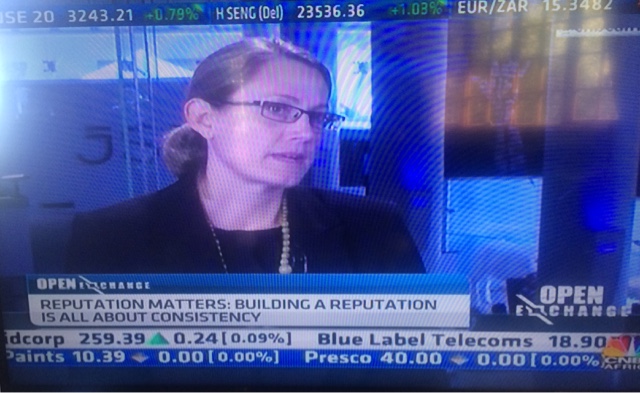
CNBC Africa interview: 03 October 2016
Subscribe to:
Posts (Atom)