Tuesday, 25 October 2016
Motivation through storytelling
It really is all about how you make others feel. Great video on the effectiveness of getting your team to share stories and motivating each other:

Tuesday, 18 October 2016
BizConnect: Clear the clutter you normally overlook in business
Here's my latest BizConnect contribution:


Make time to clear out the clutter and remember to clean up your databases too. Engaging with the wrong people will waste a lot of your precious time, and we know that time it money.
Spring Cleaning
Isn’t it interesting how quickly spaces can get cluttered with non-essential items, not to mention how paperwork can pile up on your desk?
Spring is in the air and it is time to clear the clutter. Something to consider adding to your ‘to-do’ list of things that need to be up to date and cleaned out is your database of contacts.
Would I be right in assuming that you have a massive database of contacts?
As entrepreneurs, we feel that we want to reach out to as many people as possible and we often believe that our product or service is something that anybody or any business can use. If your answer is “everybody” when you get asked who your clients are, then the next part is specifically for you.
Not everybody is right for you. Let’s face it, there are clients and projects that you enjoy a lot more than others.
Have a look at your client list, current and past, and do a quick analysis of who you really enjoyed working with. Determine which projects were most profitable, which the energy drainers were, and which took way too long and was least cost effective. The aim is to find those projects and people that you resonate with the most. This is definitely one of the things that I should’ve, could’ve done a lot sooner on my own entrepreneurial journey. I’ve spent way too many hours on projects that were not quite aligned to our core service, which took away a lot of valuable time from pursuing the ones we really enjoy working on. Once we identified who exactly our target was and as we continue to refine it, it is as if those puzzle pieces fall so much quicker and easier into place.
Work through your contacts on LinkedIn and see whether all of those connections are truly beneficial.
If you don’t use a Customer Relationship Management System, invest in one. Business is about forming relationships, and keeping track of these relationships are key to building your business. Personally, I like a programme called OnePage, which enables us to keep track of all our engagements with leads and clients. Make sure that the names and surnames are spelled correctly, their position, contact numbers are correct and that you have their correct email address.
This is important for when you share marketing material; if you are going to personally address them and you don’t spell their name correctly it won’t be the greatest first impression that you are making.
Having an updated contact database is also crucial from a crisis communication and management perspective. Let’s say there is a crisis; are you in a position to contact emergency services, employees, suppliers, partners, and the media at the drop of a hat? What if it is over the weekend? Does everyone know who to contact? Not communicating quickly enough, especially during a crisis, to the right people can have a massive reputational risk for you and your business.
Keen to continue the reputation management conversation? Join Regine on Twitter @ReputationIsKey or Facebook www.facebook.com/yourreputationmatters.
Do you have a reputation management question? Send your query through to Regine on: regine@reputationmatters.co.za
Tuesday, 11 October 2016
Leadership Magazine: Keep them interested from start to finish

Here's my latest Leadership Magazine contribution:
At a recent conference, I sat in a session where I was (unpleasantly) surprised by a key speaker who read to us; I had looked forward to the session and really wanted to hear what the person had to share, alas my attention and interest levels dwindled when the monotonous tone of her reading droned on.
For the love of all things that matter, when you are asked to speak at a conference, please don’t address the audience by reading your speech or presentation to them.
When you are a speaker, you would have been asked to address the audience because you are an expert and / or leader in a certain field. I totally appreciate that public speaking is not everybody’s cup of tea. In that case, if you are in a leadership position, or get asked to speak to a group of people on a regular basis, invest in an expert’s help to overcome your fear of public speaking; the investment is well worth it. My recommendation is to consider investing your time and money in an organisation such as Toastmasters. It’s a great way to practice speaking in front of a crowd and to build confidence, helping you realise that the earth won’t swallow you up when you open your mouth. They will also teach you all the different public speaking protocols and etiquette nuances that you need to make a lasting impression with your speech.
If, however, you’ve just been asked to deliver a presentation and you need a few immediate tricks, these are my eight favourite tips to get you through your speech:
1. Write it, don’t read it: By all means, write out your speech if this will help you to structure it and to see where best to bring in your key points and messages. However, please don’t be inclined to take all the folios of paper with you to the podium. This will pose an unnecessary temptation for you to read it. If you’re not quite ready to address the audience without your ‘paper crutch’, then consider writing down keywords onto cue cards that you can use as prompts throughout.
2. Text is boring: You can use PowerPoint very effectively as a prompt as well. Don’t be tempted to present slides and slides of text to your audience. Being presented with a lot of text is boring and you will lose your audience’s attention. People are generally visual beings. Instead of a slide with a lot of text on it, consider using an interesting image or cartoon with a couple of keywords and then speak around each image. People are there to listen to you, not to read your slides.
3. Tell a story: you’ll have a more engaged audience if you share a story or something personal with them. Not only will your audience be keen to hear more, they are a lot more likely to listen to you and remember what you said.
4. Don’t forget the eyes: When you read your presentation, your eyes are cast down and you immediately cut off your connection with the audience. Make eye contact with different members of the crowd throughout your speech in order to make them feel involved. Be warned, this could be a bit difficult if everyone has their faces buried in their phones (hopefully) tweeting away about your amazing talk. Cast your eyes, then, to the non-tweeters.
5. Don’t worry if you forget: the audience are there to listen to you and your insights; they don’t know what you were or were not going to say. You are the expert, so if you’ve forgotten something during the talk, don’t worry about it. You can always swing back to a point if you remember it later on.
6. Practice practice practice, the more familiar you are with the content and what you want to say, the easier it will be and the less you will be tempted to look at your notes! There is an old adage, ‘fail to prepare, prepare to fail’. We are often quite surprised as to what our voices sound like, so practise out loud; don’t just practise your speech in your head. Record yourself in order to pick up any unnecessary repetition or any ‘crutch words’ which you may tend to rely on, as these could potentially detract from what you are saying. Practising in front of the mirror will also help make you aware of any gestures that could distract the audience.
Earlier this year I had to present at a conference. There was a technology glitch with the system, which basically meant that I had to start presenting while they pressed buttons to try and get my presentation onto the screen. If I had not known my presentation backwards and had practised it many many times, it could have been absolutely disastrous. As murphy would have it, the presentation worked the minute I finished answering the last question.
7. Mic up: personally, I don’t like microphones; however, you really do want the person at the back of the room to hear you too. If there isn’t a microphone, practice projecting your voice, you’ll lose your audience if you are too quiet. Also, practise using pauses throughout (note them in your cue cards if need be), it can make quite an impact to get a point across… if used correctly.
8. Time yourself: Ensure that you know how long you are talking for and that there is enough time for questions. Regardless of how interesting your talk is, keep to the time allocation, in this way you are respecting the time of your audience.
Make sure that your speech is remembered for all the right reasons.
Keen to continue the reputation conversation? Join Regine on Twitter @ReputationIsKey or Facebook www.facebook.com/yourreputationmatters.
Tuesday, 4 October 2016
CNBC Africa interview: 03 October 2016
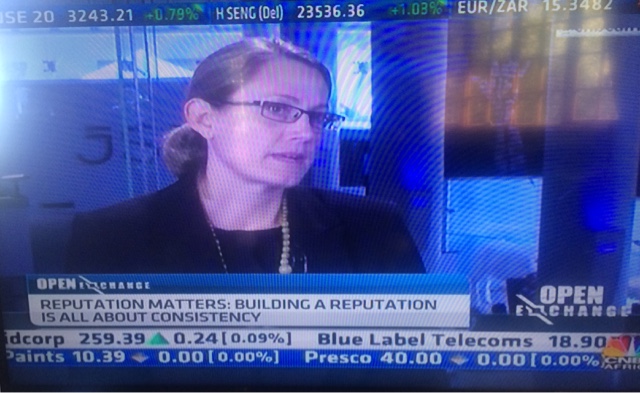
Tuesday, 20 September 2016
Leadership Magazine: The Master's Voice

Leadership Magazine, page 118
Jack
of all trades, master of none; is your communication expert a good fit?
If
you were to handle a lawsuit without the necessary legal advice and council, or
audit your own books without the needed skills of a professional, you know that
you are setting yourself up for failure. Not investing in professional help in
either of these could have a dire impact on your business on so many levels.
Communication, if not managed professionally, will also negatively impact your
business and you could run the risk of ruining your reputation.
Fortunately,
more companies are seeing the benefit of investing in their reputations
compared to ten years ago. Unfortunately, there are many charlatans out there
that have jumped on the ‘reputation’ band wagon and have taken many
organisations for a Public Relations (PR) ride. I honestly can’t blame some companies
for being wary about investing in communication / PR agencies; I’ve heard some
shocking revelations of what some agencies get away with, with high retainer
fees to boot!
Whether
or not you are sceptical about engaging in the services of a communication
manager, have been dabbling with the thought of getting someone on board, or
just wondering whether you are getting the most out of your current service
provider, use the pointers below to help find or confirm that you have the right
communication fit in your organisation. This will essentially help you to manage
and maximise your communication initiatives to ultimately take your reputation
to the next level.
What should you look for when selecting a
communication consultancy?
Firstly, have an agreed road map:
- Does the agency make an effort to understand your organisation? They need to live the brand to effectively communicate about the organisation. If they are not integrally involved in what you do, how can they successfully communicate to others what you do?
- Do they ask about the business’ goals and is this incorporated into the overall communication goals?
- Is there a clear agreed upon communication vision? Does this feed into the overall business vision?
- How do they bill? This is quite a grey area, especially as there are no set industry fees and rates. Some agencies bill per hour and allocate a set number of hours to each client. Other prefer to bill per project, while others opt for a retainer fee. Personally I recommend a monthly retainer fee with very clear deliverables that need to be reported on. Building a reputation takes time, and it is quite tricky to do this if the focus is only on an ad hoc project basis. With a retainer you can have a much longer term view and build a stronger relationship if both parties know where you are heading to and what it is going to take to get there. I do understand that investing in a retainer could be quite daunting especially if you have not had a good experience in the past. Consider negotiating a shorter term engagement and take stock after a couple of months to see what is working, what is not working and readjust where necessary.
Secondly,
find out about range of expertise of the agency.
- Are they able to cater for your specific needs?
What is tremendously helpful is to give a comprehensive brief of what you
require. This will make your life considerably easier when it comes to
evaluating the proposals received.
- Find out what their area of expertise is. Many
agencies offer a full integrated communication service. - be wary of this.
Ultimately there will be one area that they are far better at and that
they will focus on more. You want a specialist to help you, not a jack of
all trades. Collaboration is the name of game; consider a couple of
experts in different areas.
- It’s good to find out what experience they have
in your particular market and particular disciplines. With that said,
if an agency has not worked in a specific industry, don’t let that put you
off. A fresh pair of eyes could just be what is needed on a new approach
to get your message out there.
Thirdly, who will be working on the account: resourcing?
There are pros and cons when
it comes to investing in a ‘one-man-show’ versus a dedicated team (agency).
When you invest in a
consultant, you are investing in receiving their personalised service,
unfortunately when they are ill or go on holiday there isn’t a backup team that
can help out.
Investing in an agency gives
you team support, and you have a group of experts to tap into as opposed to just
one person. The snag is that when the proposal gets sent to you, you are
promised the highest calibre resources and then once the contract is signed,
you are assigned the newest intern to manage your account. You can and need to
be quite clear who you would like to work on your account from the beginning.
Regardless of who you select
to work with, the most important thing is that there is a good rapport between
you and them.
The
fourth area to look at is measuring the results.
- Find out what the measurement / return on investment of the service will be. Having clearly defined goals in place helps immensely to make sure that all parties are on the same page and knows what need to be done. You could consider linking a deliverable to a business goal.
- How and when will progress be discussed; a monthly report is highly recommended to keep track of progress, as well as quarterly or annual review.
Finally, the agency’s reputation matters. Make sure
that their values resonate with those of your company. Ask for references, and
speak to their current and previous clients. Find out whether they belong to
the industry body, as there would be a code of ethics that members would agree
to. How do well-informed people judge the consultancy? Lastly, do they practice
what they preach? Read their work, and also see how they represent themselves
in the media.
To
recap when it comes to investing in a communication agency:
- Have an agreed road map; align the communication
strategy to the business;
- Confirm
the range of expertise that the agency has to offer. Would a specialist or
jack of all trades work best for you?
- Find out who you will be working with. Make sure
that you resonate with the person or team that you end up working with;
- Have
clear measurable goals in place to track progress and to measure your
return on investment and finally;
- Reputations matter, investigate the agency thoroughly and get
feedback from current and previous clients before investing in a long term
engagement.
To continue the reputation management conversation,
join Regine on Twitter @ReputationIsKey or Facebook www.facebook.com/yourreputationmatters.
Tuesday, 13 September 2016
Book: Scaling Up, Verne Harnish

I received this book from a business coaching organisation, which I am very grateful for. For my own personal reasons I have a slightly dim view when it comes to coaches; I do however totally agree with the concept of it. I'll leave my thoughts about the subject for another time.
I really enjoyed this book, it focuses on People, Strategy, Execution and Cash. You don't have to read it in that order. I read the strategy part first; personally I feel that you should first have your business' strategy in place, know where you are heading to, before you can put the other pieces of the business together. I really liked the templates that they provided, and I look forward to working through it with my team during our next strategy session as well. There are wonderful lessons and examples for each of the focus areas. I've really enjoyed working through the book every morning before work.
Verne Harnish also has a really good newsletter, which is worth subscribing to.
Highly recommendable.
Wednesday, 7 September 2016
Are you making time for the big rocks in your life?
Sometimes it is good to be reminded of some
life lessons, especially when we feel that life becomes all-consuming with emails
/ social media / unimportant little things.
This video clip of Stephen Covey is worth investing 12:30 minutes of your time (it’s an oldie, so enjoy the fashion).
Subscribe to:
Posts (Atom)